


HUGO — They say the third time’s the charm, but for the annual Hugo citywide bus tour, the second time did the trick.
For the first time in 19 years, the tour had to be rescheduled after the bus broke down in the parking lot where it was scheduled to pick up riders at Oneka Elementary School. A couple of weeks later, everything went off without a hitch.
Each year, elected officials, commission members, residents and city staff use the tour as an opportunity to review what happened during the year and what’s slated for the near future. Discussions at the event then leads to forming the goals of the City Council and various commissions for the next year.
Going into 2026, those discussions will also help kick-start the city’s update to its 2040 Comprehensive Plan. Over the next three years, the city will work to draft the plan for the next decade, 2050.
“The main purpose of the bus tour is to use this information to evaluate how we are doing,” City Administrator Bryan Bear explained. “This is not just about accolades. We are not just here to brag about what’s happened here in the city of Hugo. We want to learn from what’s happened. So, if we’re doing something right, we want to keep doing those things that are right. We want to recognize that we try things out … When we try something, it isn’t always perfect, and it doesn’t play out the way that we wanted or the way that we planned.”
Bear explained that housing is an important topic, not only for the city of Hugo, but all cities in the state. Each year at the Capitol, zoning preemption legislation is introduced that tries to limit what cities can use zoning for. One example is legislation that would prohibit single-family zoning, meaning a city would not be able to create a zoning district that solely allows single-family homes.
“Our city, and cities in general, really believe that zoning is a tool that should be used responsibly and should continue to be used. It is the reason that we can do things so well in so many circumstances,” Bear said. “It does provide for predictability in developments. It can provide for some of the outstanding neighborhoods that we have here in the city of Hugo, and we have a lot of ways within our zoning ordinances to allow for affordability when we want to and to allow for all kinds of creative solutions to housing dilemmas.”
One such dilemma is affordability. “In the city of Hugo, we want to be responsive to the market. We want to provide housing that is realistic, and we think with creativity, we can still provide lots of options,” Bear said. “The struggle is, the path to affordability is very elusive. The apartment units are going to have expensive rents. The smaller lots still have expensive homes.”
Several different residential housing developments were highlighted on the tour, including:
• Oneka Prairie. The homes are built on 65-foot-wide lots, and the homes are approximately 15 feet apart. Per the city’s zoning ordinance, lot widths are required to be 80 feet, but the developer requested flexibility for thinner lots in return for some added amenities like Prairie Park, a pocket park.
• The Meadows at Hugo. The homes are built on 45-foot-wide lots. The one-story homes can be as close as 10 feet apart, while the two-story homes are about 15 feet apart. Bear noted that due to the narrow lots, the price points at $450,000 are a bit lower than in other Hugo developments in Hugo. “Is it affordable? I don’t know. Probably not,” Bear said. “That is more affordable than most other homes that are being built in Hugo right now … We tried it. You can be the judge.”
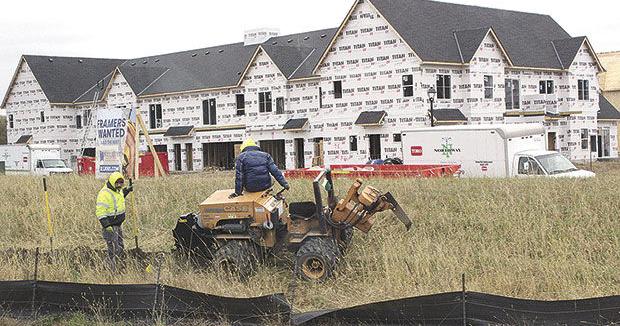
• Oneka Fields Apartments. There will be five 12-unit buildings for a total of 60 units. Bear explained that they look more like townhomes, but do not have property lines going through them. “This is a product that we are trying,” he said. “These are not the gargantuan apartment complexes that you’re seeing getting built all over the metropolitan area. This is an idea that is different from that. There’s a need for alternative housing styles.”
• Oneka Shores. Early in the development, some duplexes were built, but the developer requested “carriage homes” in the next phase. “The developer has decided that those duplex homes were not marketing well. They were having trouble selling them,” Bear said, noting that half of a duplex was selling for $500,000. “They did not find a market for that, and so they adjusted to the market. The market told them that they needed detached homes, so they split their duplexes apart and created detached units, and now they are selling like hotcakes.”
It’s also important to note that future phases of the development are expected. “The landowner has decided to sell, and we expect applications to come very soon,” Bear said.
• Watercrest of Hugo. The homes are on 80-foot-wide lots. “This is what the zoning ordinance requires, unless you get flexibility. This is what you get in a standard single-family neighborhood according to the current zoning rules,” Bear explained. “You’ll see the sign that says starting in the $600,000s. Good luck! I will guarantee there is no home in here that starts with the number 6, not even close.”
• Arbor West. The 89-unit apartment building being built across from Rosemary Apartments is an example of a project where the developer had to request a zoning change. The property was previously zoned commercial. “My view is that it will likely fit in quite well … But that is the same discussion that will repeat itself as we move forward within the realities of the commercial real estate market,” Bear said.
Development opportunities
• Graves property. The 67-acre property is located along Oneka Lake Boulevard N. Over the years, Bear says the city has received quite a bit of interest from developers interested in the property. The property is currently zoned low-density residential, which allows for about one unit per acre. Developers would like to see a higher density allowed. “We believe there will be a day, and it’s probably sooner rather than later, where somebody is going to ask us to change this (zoning),” Bear said.
• LaValle property. Located on the corner of Highway 61 and Frenchman Road/County Road 8, there is over 90 acres of land that is undeveloped. Survey crews have been seen staking the property, and Bear said city staff expect to see a development application over the winter. The challenge with the property over the years has been that it is zoned commercial, which is not in high demand. “I would expect a significant amount of this property to be proposed for residential. They would need to request a zoning change,” Bear said.
• Kwik Trip. Bear confirmed that the city of Hugo has a pending application from Kwik Trip to construct a new store on vacant property located near the Highway 61 and 159th Street roundabout. The Planning Commission is set to review the application at its Dec. 11 meeting.
• 165th Street. The city is currently conducting a street study for the 165th Street corridor. Bear explained that the recently installed lift station is the “key” that will open up the corridor for development opportunities. “All of this open land that you see, it’s all being staked for a future development application that we expect to receive here very soon,” Bear explained. “One question is, what should the road look like? Should it look just like the way it looks now with pavement on top of it? Or should it look like 130th Street? If we just pave over the gravel, of course, that’s easier. If we want to create 130th Street here, that’s very expensive and difficult.”
• Bald Eagle Industrial Park street project. The streets within the industrial park are slated for an improvement project in 2026. As a part of that project, the city hopes to extend the Hardwood Creek Regional Trail, which is under county jurisdiction. “We believe Washington County should rebuild that trail at the same time that we are rebuilding the street … It is not in their capital improvement plan for next year,” Bear said. “If they do not do it next year as part of our street project, it will be far more expensive when they decide to do it as a standalone project in the future. We are having those discussions, and hopefully we can coordinate those two projects to happen at the same time.”
• Otter Lake Road extension. The city of Lino Lakes expects to build out Otter Lake Road in 2026 to run parallel to Elmcrest Avenue. “That road will include a trail, and it will be the main north-south route parallel to I-35E. All these vacant fields are in the city of Lino Lakes, and it’s all nonresidential development in their plan,” Bear noted. Bear explained that several years ago, the city of Lino Lakes did a market study, which determined that the city has a 184-year supply of industrial land.
“Industrial is replacing a lot of commercial. The goods that you used to buy in stores, now they are not in stores; they are in warehouses. And so, as Lino begins to plan for development along this corridor, we should anticipate a lot of warehouse development,” he said.
The city of Hugo is working with the cities of Lino Lakes, Forest Lake, Columbus as well as Anoka and Washington counties for improvements that will be needed on Elmcrest Avenue, which will hopefully occur at the same time as the Otter Lake Road improvements.
• Hopkins Schoolhouse. Bear described the project as a “tremendous success story.” With the exterior renovation complete, focus has shifted to the next phase of renovating the interior. The City Council is starting discussions about what it should do, if anything, to help the project’s momentum. “No tax dollars have been spent on the restoration of that building. It has been all private donations and volunteer work,” Bear explained. “The council has suggested they want to start talking about whether the city should help accelerate the finishing of that building.”
link