


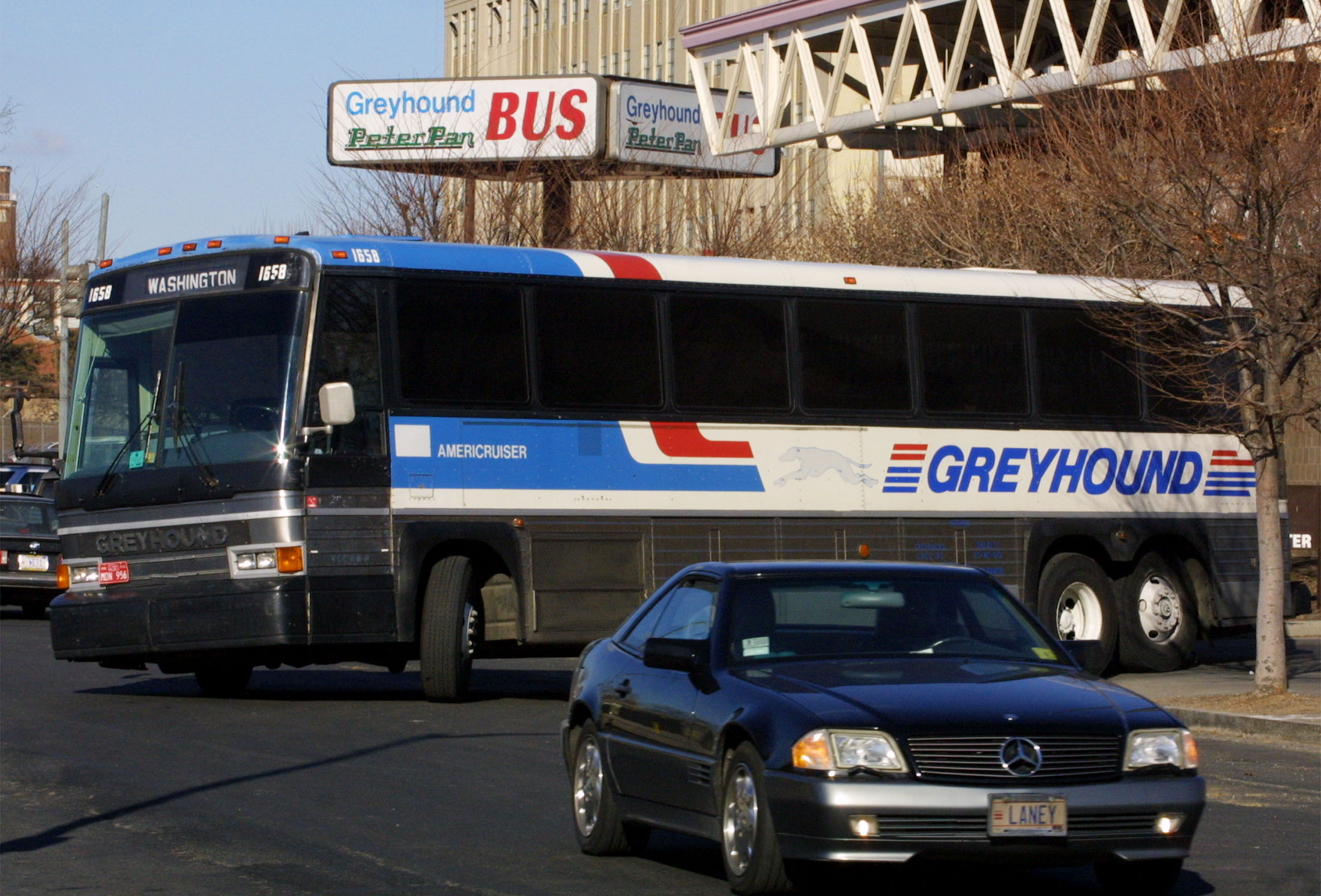
I remember my disappointment boarding a Greyhound bus for the first time in the mid-eighties. I had inherited a vague mythology of epic journeys and vistas, artists escaping small-town America — Warhol, Dylan — and a very English, self-deprecating assumption that a Greyhound had to be bigger, shinier, and swifter than a National Express coach. The one I travelled in was cramped, gloomy, smelly, and overheated, and the journey along an East Coast highway took all of three hours. The motels and neon signs were filmic, just about. The bus was the pits.
Joanna Pocock is Irish-Canadian, resident in the UK; she is more familiar with American buses and road culture, but is still an outsider. In 2006, when she was thirty-nine, following several miscarriages and the death of her sister, she decided to journey from Detroit to Los Angeles and, being a non-driver, used Greyhound. In 2023, now in her fifties, she repeated the journey to write this book, to compare the US — post-Trump, as the digital revolution transforms everything (including travel) — and herself, then and now. Quoting the French anthropologist Marc Augé, she writes that visiting ‘places of memory’ is an opportunity to face ‘the image of what we are no longer’, and to be ‘tourists of the private’.
The past and present trips sometimes merge; it must be intentional, as it seams a time-eliding quality into the narrative that fits well with Pocock’s conversational, clear-thinking prose. She’s good company, divulging the grimness of American cities and the bus-ride experience, relating the eavesdroppings, humorous and otherwise, and random encounters that are a central part of long bus journeys, while sharing her reflections on race, gender, environmental disasters and ‘appification’. She wears her erudition lightly, neatly splicing in the art and literature of the American road, from Kerouac, Steinbeck and car-obsessed male authors, to Irma Kurtz, Simone de Beauvoir and Edward Hopper, to less familiar authors like James Rorty, whose 1936 book Where Life Is Better: An Unsentimental American Journey is an angry, incisive report on working conditions in US fields and factories, and — Pocock’s favourite — William Least Heat-Moon’s Blue Highways: A Journey Into America, an account of a 13,000-mile trip through small towns, which he took when he was fired and his marriage ended.
It’s just as well she’s a convivial, entertaining companion. The trip is no joy ride. Buses break down and fail to show. Apps don’t work. People lose their phones, the only proof of a ticket. Drivers are bad-tempered or just bad. One gets lost and quits her job mid-trip. Cabbies cheat. Strange men are leches and creeps. The buses are filthy, with broken armrests and pane-less windows, with no light to read by. Fellow passengers watch violent video games. Bus stations are unstaffed. There’s no food in the vending machines. A passenger is arrested. A passenger is too friendly and boring, and ‘on a bus there is no escape’. One bus catches fire.
Episodic travelogues have in-built suspense. For a time, you think things are just going a bit wrong and soon the journey will begin properly, and we’ll be on our way. But we never get to that stage, and part of Greyhound’s originality resides in this sense of never quite taking off, of drifting day after day. Buses often terminate in suburban zones, with their latent risks, and Pocock stays in one-star (but rarely inexpensive) hotels in what she terms ‘edgelands’ (though, in American cities, I’ve often had the feeling there are only edgelands, and even centres usually feel like skyscrapered margins). There are few ‘sights’ or landmarks. A visit to urban farms in midwinter finds staff absent or too busy to talk. The countryside is witnessed but not prettified, described in terms of feedlots and ‘faecal dust’, landfill and nuke-damage.
True to its title, Greyhound explores, above all, the bus experience. Without swerving the discomforts, the poverty and mental ill-health of many passengers, or the history of racial segregation on Greyhound buses through to the Sixties, Pocock defends the crucial role they play in enabling long-distance travel for those who cannot afford to fly or don’t own a car. The bus is anti-macho, anti-individualistic, and anti-car and, therefore, in some ways, anti-American.
Early on, she writes: ‘The communal aspect of travelling by Greyhound is crucial to seeing a side of ‘America’ that very few people want to acknowledge and even fewer actually inhabit, even fleetingly. Passengers travel by bus because it is the cheapest way to move from one place to another. There are more stuffed garbage bags on a bus than suitcases on wheels. The Greyhound is where you meet those who, despite wanting and deserving a better life than the one they have, are stuck for various reasons: luck, fate, bad choices, unfair circumstances or illness.’
A hundred pages later — after many café and diner-stops, some solitary, some shared with fellow travellers, at dusk and dawn — Pocock leans into the communality. ‘On both of my trips, I found a strange sort of transcendence on the Greyhound. The shared experience of a group of humans, all of them wanting to get where they need to go, hoping for some kindness, some love, something that might be just out of reach or remembering something they had left behind him and were regretting.’
The crappiness of the mode of transport is no more than a reflection of the unfairness of the US economy and way of life. Rich Americans holiday in campervans the size of buses. Poor Americans, who never go on holiday, have to travel in buses that have the atmosphere of makeshift camps. They see the massive beast’s underbelly on their bus journeys; they live in it when they arrive. The raw, enforced humanity of the enterprise is its one saving grace.
Travel opens up a country that is sickeningly despoiled by farming and industry — and by roads, vehicles, tourism, and logistics. The ‘ever-present now’ of travel, if it liberates Pocock’s writerly imagination, perturbs her. Citing the pioneering conservationist and philosopher Aldo Leopold, she compares humans to cranes — birds that, in the singular and as a species, have a deep connection with a tiny patch of wetland and its cycles, while humans mobile, anxious, mechanised, trapped while moving at speed — are unmoored and lost in a haze of ungrounded, relentless appetite and egotism.
The paradoxes are powerful. We cannot know the world without venturing to see it. But is self-knowledge the quest or the thing we’re escaping from? Pocock’s journey, anchored in personal tragedies, is an engaging, revealing evocation of loss, at many levels, and lives, especially of the kind edited out of much travel writing. Travel — as in, the leisure business, the inanity of the bucket-list and the surfeit of social media sharing and comparing — hasn’t changed as much post-pandemic as many people expected, as much as it should have done if the world is to get a grip on the climate crisis. But travel writing does seem to be changing, as women write more, from different angles, about different places and experiences. Greyhound is a prime example of a flourishing new genre.
link