BUSD families still adjusting to school bus stop removals and route changes
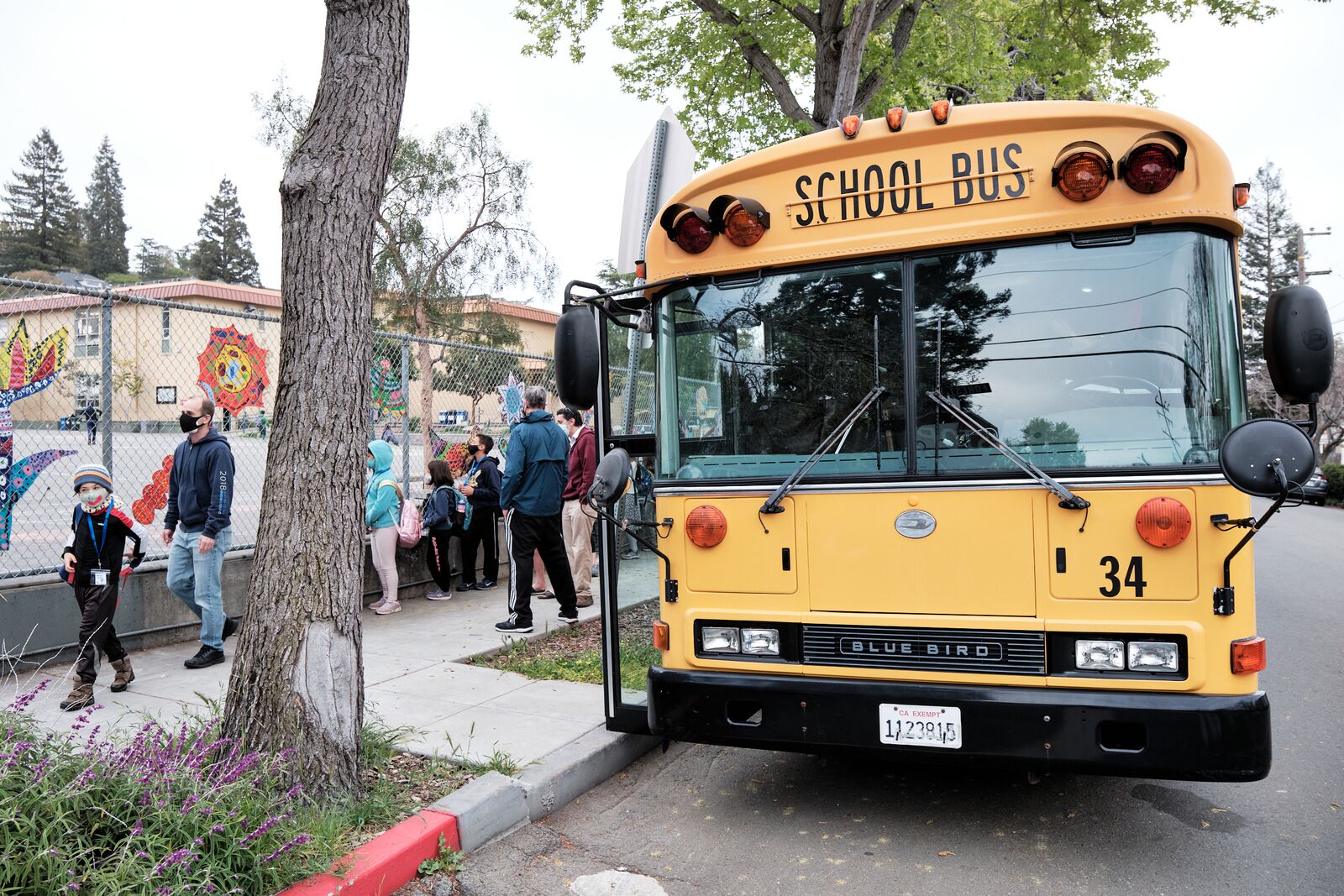

With Berkeley Unified families still adjusting to school bus consolidations a month into the new academic year, district records obtained by a parent and shared with Berkeleyside provide more detail on the route changes and service reductions.
The district announced in late July that it had consolidated its routes to improve safety, increase efficiency, reduce student ride times, address an ongoing shortage of school bus drivers, and “optimize resources.” This included the removal of all bus stops on Grizzly Peak Boulevard, which the district attributed to safety concerns. A California Highway Patrol (CHP) spokesperson also told Berkeleyside in August that BUSD’s decision to remove the stops was “due to (the school district’s) own safety concerns after multiple crashes.”
BUSD did not specify in its July message to community members which locations would be impacted. Families were advised to check StopFinder, a school bus locator app used by BUSD, for notifications about their child’s assigned stop location and ride times.
The changes left some families scrambling on short notice to find other ways to get their children to and from school when instruction resumed in mid-August. This included about 30 families in the Berkeley Hills impacted by bus stop removals on Grizzly Peak Boulevard, who said the alternative stops offered by the district are too far away from their homes to be useful.
One of the Berkeley Hills parents, through a public records request, subsequently received two lists of BUSD bus stops comparing the 2024-25 and 2025-26 school years and shared them with Berkeleyside. BUSD did not share these documents directly with Berkeleyside, citing privacy concerns. None of the specific bus stop locations or other potentially sensitive information has been published in this article.
The lists show the district operated 191 stops last year, compared to the current 150. After accounting for what appear to be duplicate records and possible errors in the current list, Berkeleyside was able to confirm that at least 19 stops were removed from service this year, and at least 14 new locations were added. There also appear to be slightly fewer escort stops where the bus driver walks children across the street.
School bus stops were consolidated across the city, BUSD spokesperson Trish McDermott told Berkeleyside in an email Thursday. New stops were selected to ensure students had “reasonable” walking paths without needing to unsafely cross major roads.
“BUSD values our families and the diversity that our student assignment process creates,” McDermott said. “We are committed to continuing to work with families and our city partners to improve and ensure access to all of our excellent district schools.”
For some families, new BUSD bus routes have made getting to school harder
Four weeks into the new year, Berkeley Hills families with children attending Sylvia Mendez, Oxford, and Malcolm X elementary schools, among others, said they are still struggling.
“The whole idea of the bus is to make it easy to go to a non-neighborhood school, right?” parent Niña Caculitan told Berkeleyside.
Caculitan, whose family lives in the Berkeley Hills, has a first-grader at Washington Elementary. She said they live far from the school, and the drive time is lengthened due to the commute through downtown. This year, their stop is nearly a mile away from their home on hilly ground. Additionally, her child has to catch the bus a few minutes earlier this year, and her school’s start time is also later, meaning children are spending longer times on the bus.
Yumi Lifer has a first and a fifth-grader attending Washington Elementary. She said that for many families in the Berkeley Hills, this is not their first choice, preferring a closer school.
“A huge reason why we didn’t argue with the district about our final placement was because there was a busing service,” Lifer said.
The family’s stop was previously located about a five-minute walk from their home. But Caculitan said their bus stop this year is now more than a mile away, making it inconvenient to use the service. The family opted out of the program and is organizing a carpool with the family of a third-grader down the street. She said others are also driving their kids to school.
Some BUSD parents said they have suggested locations for closer bus stops in the Berkeley Hills, such as areas along Shasta Road. The district said Shasta Road isn’t an option, however, since it has double yellow lines and would require the bus to travel on Grizzly Peak Boulevard. A spokesperson said the district considers all suggestions and is still exploring alternative routes and stops.
BUSD records obtained by parent shed more light on bus stop changes
These frustrations led to BUSD parent Maksim Ioffe seeking more information about BUSD buses through a public records request. Ioffe rode the subway for nearly 90 minutes to his high school in New York City and does not want his kids to experience long commute times.
His oldest child just started kindergarten at the Berkeley Arts Magnet, and this is the family’s first time dealing with school bus transportation. They live high in the Berkeley Hills and now drive their child to the newly designated bus stop. He said the school bus has not arrived on time once this year.
“Whoever planned these routes didn’t fully figure out how long it takes for the bus to drive from the beginning to the end,” Ioffe said.
Unlike the district email to families, which was sent out roughly two weeks before the start of the school year, the two bus stop lists obtained by Ioffe reveal where the district changed its stop locations and transportation routes.
The lists show bus stops were added around some schools and in recreational areas, such as Shorebird Park in Berkeley Point, one site for the district’s after-school program, LEARNS. There are new stops by John Muir and Sylvia Mendez elementaries, Willard Middle School, and at the New School, a preschool that also offers an after-school program for elementary school kids. A few stops were also added in West Berkeley, expanding transportation access in some of the more underserved areas in the city.
Elsewhere, some stops were removed on busy roadways like California Street and Channing Way, possibly to reduce congestion. Other stops that appeared to be close to each other on the same route were also removed or consolidated.
The district on Thursday shared more information with Berkeleyside about bus reroutes and consolidations.
In creating new routes, BUSD aimed to centralize neighborhood bus stops to allow for shorter and more direct routes that improve punctuality and reduce fuel consumption, McDermott said. Having fewer stops will allow BUSD to make better use of its short staff, reduce driver burnout and the need for contractors, she added, and the consolidations will also free up drivers to support the athletics department and field trip transportation.
BUSD’s new route models estimated a 15-minute reduction in average ride time for elementary school students, said McDermott, and aim to create safer drop-off and pick-up locations for students. After-school program locations did not influence where bus stops would be located this year, she said.
Some fear bus changes could roll back BUSD’s progress on school desegregation
New bus stop locations and district talks about charging a “modest fee” for transportation have left some community members wondering what is in store for BUSD’s cross-city busing system, the first in the country voluntarily implemented by a district to help desegregate schools. The district said fees will be waived for students eligible for free or reduced meals, homeless youth, and children in foster care.
District officials have said bus fees are part of BUSD’s efforts to balance the budget. Leadership is working to create the appropriate infrastructure to collect these charges, though BUSD has not indicated when they will be implemented. BUSD said these charges are not related to bus route consolidations. Families will be notified in advance of any fees, according to the district.
A few parents said they are receptive to paying for school bus transportation as long as the service remains convenient. Some have also voiced concerns about these changes disrupting BUSD’s efforts to reflect the city’s diversity in classrooms.
“Requiring public school students to pay for the school bus facilitates segregation, inequity, and undermines more than 50 years of work to integrate public schools and provide opportunities for all of Berkeley’s children, regardless of race, ethnicity, and socioeconomic status,” parent Valerie Blair McDermott wrote in late May in an email to BUSD board members and leadership, and shared with Berkeleyside.
Lifer said she is concerned that new families may choose to enroll their children in other districts if they are assigned to faraway schools without convenient bus service.
“It’s such a critical core part of the district’s identity, and I would hate to see it go, especially if it means that more affluent families in the hills will make a different calculation about where to send their kids in the long run,” she said.
Parents have continued advocating for closer bus stops, requesting that the district arrange for a CHP representative to meet with them to further explain why the road conditions on and around Grizzly Peak Boulevard can’t continue to accommodate school buses. They also called on BUSD to be more transparent about bus performance metrics, such as recording tardiness on routes and commute times.
Related stories

UC Berkeley shares 160 names of students, staff with Trump administration in ‘McCarthy era’ move

BUSD is improving on literacy, but will be monitored for another year

Berkeley Unified reports COVID-19 cases at some schools in first weeks of the year
link