
Detours and delays: The strain of Middle East tensions on global air travel: Travel Weekly
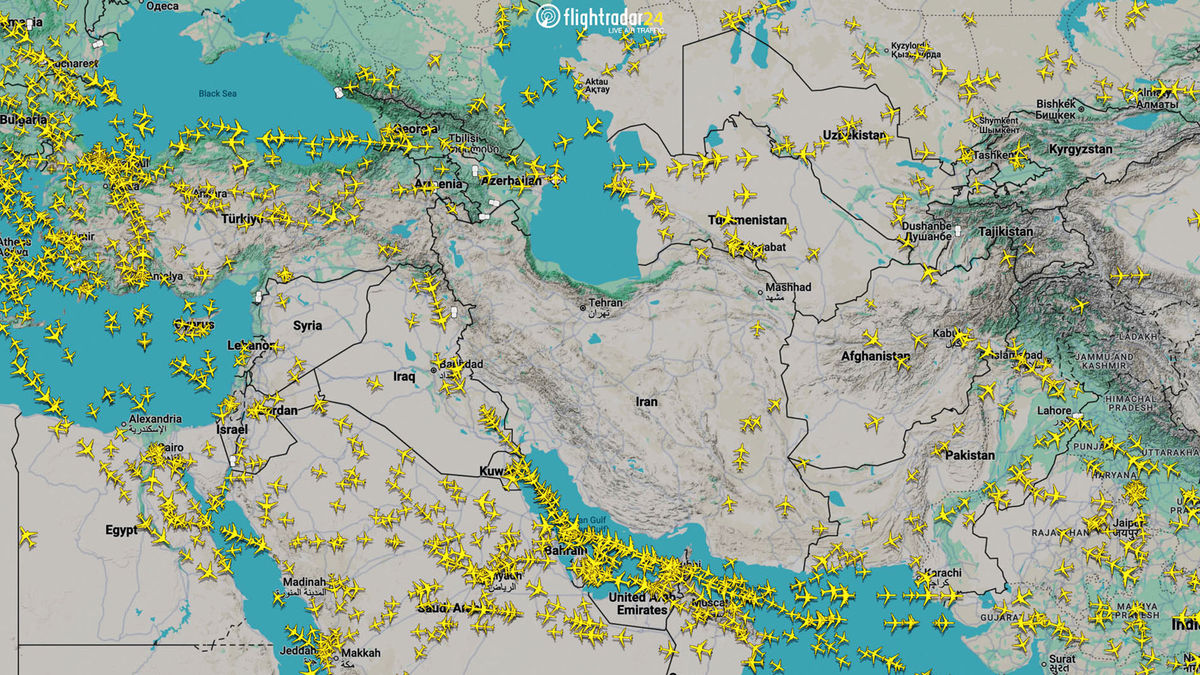
Instability in the Middle East and Eastern Europe has ratcheted up route challenges for global air carriers.
And despite the cessation of bombing over Iran in late June, the puzzle faced by many airline operations teams isn’t likely to get easier soon.
For now, most airlines are continuing to steer clear of Iranian airspace, altering routes to fly north through Turkey or south through Saudi Arabia and Egypt. The diversions have placed additional pressure on flight corridors that were already more crowded due to the closure of Ukrainian airspace in 2022 and the shutdown of Russian airspace for Western carriers.
Faced with limited choices, airlines are often forced to fly longer routes, and with less scheduling flexibility, due to the challenges of dealing with more crowded skies.
“If you’re thinking about a six-lane highway, we are basically now funneling all traffic through two and three lanes,” said Keith Glatz, senior vice president of international affairs for Airlines for America (A4A).
For U.S. carriers, the restrictions on Iran preceded the closures over Russia and Ukraine, dating back to January 2020, when tensions escalated in the aftermath of the U.S. assassination of Iranian general Qasem Soleimani.
U.S. airlines have also chosen not to fly over Iraq, though the FAA allows it as long as an altitude of 32,000 feet is maintained.
Currently, the flight risk database Safe Airspace advises against flying over Iran, Israel, Syria and Lebanon along with Russia, Ukraine and several other countries.
Cumulatively, the closures have mostly impacted India and China routes for U.S. airlines. To and from China, the closure of Russian airspace can increase flight time by two hours, depending on the route and on conditions, as carriers stay south of their usual transpacific routing.
The Russian closure, augmented by the Iran closure, has caused U.S. airlines to mostly stay out of the Indian market. United has canceled three of its four India routes since 2022. And the only U.S. airline routes to India are one each from American and United — to Delhi from New York JFK and Newark, respectively.
Due to the closures, American operates JFK-Delhi by going across Turkey, then staying north of Iran and Afghanistan before cutting sharply south toward the Indian subcontinent, data from the flight-tracking service AirNav Radar shows. In contrast, until India’s flare-up with Pakistan over the disputed Kashmir region in early May closed Pakistani airspace to Indian carriers, Air India was able to fly the preferred polar route over northern Scandinavia and Greenland, often saving 30 minutes to an hour, depending on trade winds.
The Pakistani closure, however, first led Air India to adjust its routing to go over Iran. Then came the bombing campaign by Israel, and later the U.S., against Iran. Now Air India is operating its U.S. service through the crowded Saudi Arabia/Egypt flight corridor, where it shares the skies with East/West services from European and Gulf airlines. Another popular Iran-avoidant corridor for non-U.S. operators has them cutting north/south over eastern Iraq in transit between Turkey and the Persian Gulf.
“When you funnel a lot of traffic through a small corridor, that can create a bunch of air traffic management challenges,” said industry analyst Bob Mann of R.W. Mann & Co.
One impact, he noted, is that airlines might not have the option to substantially vary their routes to find the best wind conditions.
“To have to fly the same corridor in both directions can create quite a bit of operational penalty,” Mann said.
Headwinds on alternate routes
Slower airline throughput is another pitfall, as Glatz’s reference to traffic highway lanes illustrates. He said airlines can try to fly bigger planes with fewer frequencies to alleviate that problem. But no matter what, scheduling challenges are heightened.
Longer flight times also increase fuel usage and up the difficulty of crew scheduling, especially if delays cause more frequent occurrences of crews being timed out due to regulations on crew duty duration.
And all of these issues, said Mann, impact the economics of each route, making some routes less appealing, if not unviable.
“Some of it you try, but the cost of it is so high in equipment utilization and fuel burn and staffing utilization that you cancel that stuff,” he said.
Despite all the problems caused by airspace closures, many airlines might not be quick to return to the skies over Iran. In a recent opinion published by IATA, the trade group’s senior vice president for security, Nick Careen, pointed to the downing of Ukrainian Airlines Flight PS752 by Iran in 2020 and last December’s downing of Azerbaijan Airlines Flight 8243 by what is believed to have been a Russian missile.
That second incident, he said, “was a fresh reminder that the risks in conflict zones are real.”
Regardless of whether regulators forbid airlines from flying over one area or another, carriers are obligated to do their own operational risk assessments, Careen wrote.
link